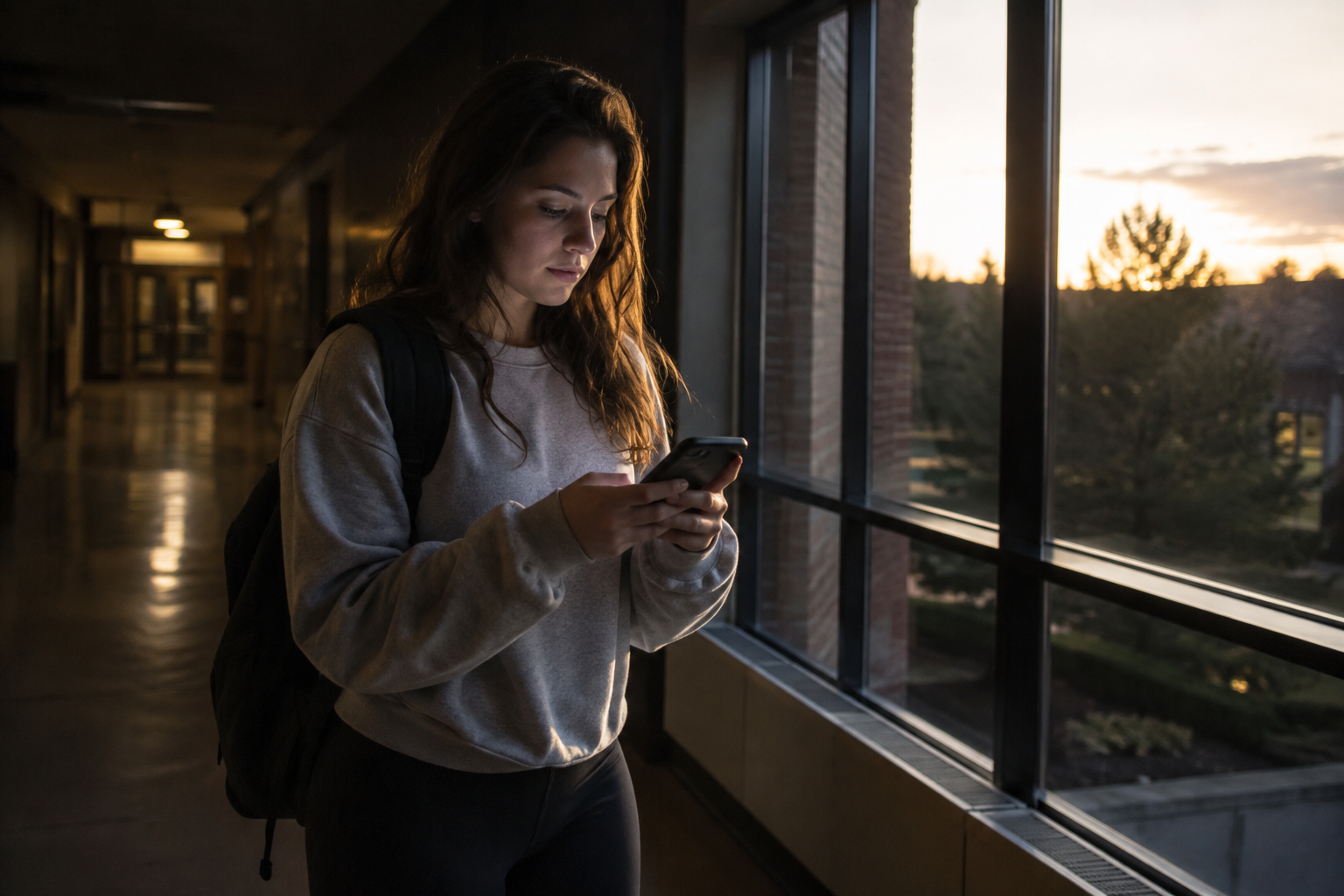
Most counseling centers close at 5pm. Most crises don't check the clock. The question of how universities keep student health and support available outside office hours has moved from a wellness talking point to a standing item on risk committee agendas, and for good reason: the gap between when students need help and when campus offices are staffed is where liability, missed disclosures, and preventable escalations tend to live.
This is an operations problem before it's a compassion problem. Deans of students and health services directors are being asked to close a coverage gap without the budget for round-the-clock clinical staff, and without pretending that an app or an answering service can substitute for a licensed professional. The institutions doing this well aren't buying a single tool. They're building a structure.
Why Student Health Needs Don't Stop When Offices Close
The data on when students actually reach out doesn't align with a 9-to-5 schedule. National surveys like the Healthy Minds Study and ACHA-NCHA have repeatedly found elevated rates of anxiety, depression, and reported distress among college students, with symptoms that don't respect business hours by definition. Crisis lines and campus hotlines have long documented after-hours and weekend call spikes, particularly around finals, midterms, and the return from academic breaks, when isolation and academic stress compound.
RAs and roommates are usually the first to notice something is wrong, and they're doing it at 11pm on a Tuesday, not during a Wednesday office hour. The JED Foundation's guidance on campus protocols is explicit that after-hours planning has to be part of a comprehensive campus safety and mental health framework, not an afterthought bolted onto daytime services. An institution with excellent 9-to-5 care and no credible after-hours student support pathway still has a gap, and it's often the gap where the worst outcomes occur.
Campus Mental Health Coverage Gaps: What Deans of Students Are Actually Facing
Small and mid-sized institutions feel this hardest. A counseling center with three or four clinicians cannot staff a 24/7 crisis line without either burning out that staff or spending money that doesn't exist in the budget. Larger universities with more resources still see coverage thin out over weekends, academic breaks, and summer sessions, exactly when students are most likely to be isolated from their usual support network.
The practical result is a patchwork: an answering service that takes a message until Monday, a generic hotline number posted on a webpage, or nothing at all. None of these tell an administrator what actually happened at 2am. None of them produce a record that can be reviewed for pattern, risk, or compliance. These campus mental health coverage gaps aren't just a service gap, they're a visibility gap, and that's what makes it a governance issue rather than a customer service issue.
Triage Without a Clinician: What's Safe to Automate, What Isn't
This is where administrators need to be precise, because vague language here creates real exposure. Automated or rules-based systems, including AI-assisted chat, can safely handle a defined set of tasks: answering FAQs about hours and services, routing students to the right resource based on the nature of their question, scheduling a warm handoff to a live counselor or advocate, and providing a pseudonymous channel where a student can ask something they wouldn't say to a person's face.
What these systems cannot safely do is clinical assessment, risk stratification, or crisis intervention. Any indication of suicidal ideation, active harm, or a medical emergency needs to route immediately to a live human being or an emergency service, full stop. Platforms built for this space, including Confide's student health and support services, are explicit that they are not a crisis service and not a medical provider. Their function is triage and routing: getting a question to the right person fast, not replacing the person. Any tool that blurs that line, or that a vendor markets as a substitute for clinical judgment, should be disqualified before procurement even starts.
The honest framing for a risk committee is this: automation reduces the number of students who fall through the cracks between "closed office" and "9am the next day." It does not, and should not, reduce the number of students who reach a trained human when it matters.
Title IX Reporting After Hours: Where Institutions Get Exposed
This is the section general counsel will want to see. Title IX reporting after hours doesn't pause because the office is closed. If a student discloses a sexual assault to an RA, a peer responder, or a chat system at 2am on a Saturday, the mandatory reporter clock and the institution's obligations under Title IX are already running. The question isn't whether the disclosure counts, it's whether the institution has a protocol that catches it and moves it to the right office by the time that office opens Monday morning.
That requires two things working together. First, a clear escalation path: any disclosure that triggers mandatory reporting, regardless of the hour or channel, needs a defined handoff to the Title IX coordinator or designee with a timestamp. Second, privacy architecture that limits who sees identifying information before that formal handoff happens. Anonymized or pseudonymous intake, PHI-free by design, means a triage system can recognize "this is a Title IX disclosure" and route it appropriately without exposing a student's identity to unauthorized staff in the process. That reduces institutional risk on two fronts: it protects the student from an informal, unauthorized disclosure of their situation, and it protects the institution from a reporting failure caused by information getting stuck in the wrong inbox over a weekend.
Administrators evaluating any after-hours vendor should ask directly how a disclosure is timestamped, who can see it before it's escalated, and how the handoff to the Title IX office is documented. If a vendor can't answer that clearly, it's not ready for this use case.
The Staffing Math: Coverage Models and What They Actually Cost
True 24/7 licensed clinical coverage is expensive and, for most institutions outside the largest research universities, not realistic as a standalone model. The staffing math usually works better as a tiered structure: an on-call clinician for genuine emergencies, trained peer responders or resident advisors for first-line human contact, and an asynchronous triage layer, SMS or web chat, that handles routing and resource navigation when no human is immediately available.
The cost comparison isn't close. A single additional FTE clinician for after-hours coverage can run well into six figures annually once benefits and on-call premiums are factored in, and that's one person covering a fraction of the week. A tiered model spreads the load: automation absorbs the high-volume, low-acuity questions (where's the health center, how do I schedule an appointment, what does this service cost), peer responders handle immediate human contact and escalate when needed, and the on-call clinician is reserved for what actually requires clinical judgment. That's not a cost-cutting gimmick, it's appropriate allocation of a scarce and expensive resource. Institutions considering this shift can see how Confide works as one example of the asynchronous triage layer in that stack, without treating it as a replacement for the clinical tiers above it.
What to Measure: Metrics That Tell Administrators the Gap Is Closing
Raw message volume is a vanity metric. A high number of after-hours contacts tells a dean that students are using the channel, not that the channel is working. The metrics that matter are outcome metrics.
Track response time to first contact, meaning how long a student waits between reaching out and getting any acknowledgment, human or automated. Track the percentage of after-hours contacts successfully routed to the appropriate resource, not just closed out or abandoned. Track no-show reduction at follow-up appointments scheduled through an after-hours channel, since a warm handoff that doesn't result in a kept appointment hasn't actually closed the loop. And where data allows, track early indicators of reduced escalation to emergency services or emergency rooms, which is the strongest signal that appropriate triage is happening upstream.
None of these require exposing individual student identities to build a useful report. Aggregated, anonymized reporting on these four measures gives a board or a risk committee something to act on. Activity counts don't.